
Identify Who Owns a Mobile County Property
Ownership questions need evidence, not guesswork. The reliable path starts with Mobile County Revenue Commission appraisal data. It then moves to the Probate Court recording trail. Each step cuts the risk of landing on the wrong lot or on a person with a similar name.
- Search the street address in the Revenue Commission property search. If the full address fails, use the street name and compare the result list.
- Open the parcel card and copy its key number, parcel number, situs, legal description, tax year, and exact Owner
Name:entry. - Use the legal description and owner name to locate the latest instrument in Mobile Probate's Landmark WEB index.
- If an entity is named, use the Alabama Secretary of State business search to identify the correct entity record. Do not treat an agent as the parcel owner.
The result carries two labels. One is the owner on the dated tax roll; the other is the grantee in the latest matching deed. When the labels differ, report both and keep digging rather than silently picking one.
Match Mobile County Property Owner to Parcel
An address is only a lead. Land needs a unique identifier, and that is the parcel. A Revenue result can display key number, parcel number or GeoID, neighborhood, legal description, situs, owner ID, and tax year. Compare several fields at once. This matters where a street has unit numbers, directional terms, or more than one municipal place name.
Key terms. The situs is the property's physical address, while a parcel number identifies the mapped tax unit. The legal description defines the tract in recorded language. Vesting tells you how title is held.
The Mobile portal offers many routes in: address, owner, key number, owner ID, parcel, neighborhood, property type, and tax year. Here those controls serve one purpose. They confirm the name belongs to the intended land.
Read Mobile County's Exact Owner Name Field
The parcel card lists the current assessment name under an Owner heading labeled Name:. Quote it as the "owner shown on the current assessment card." Save the tax year with it. That phrasing keeps the finding honest and dated. The county itself treats this data as appraisal information rather than legal conveyance documentation. The official sample parcel card shows owner, situs, key, parcel, legal-description, value, and deed-history fields. They all sit together on one page.
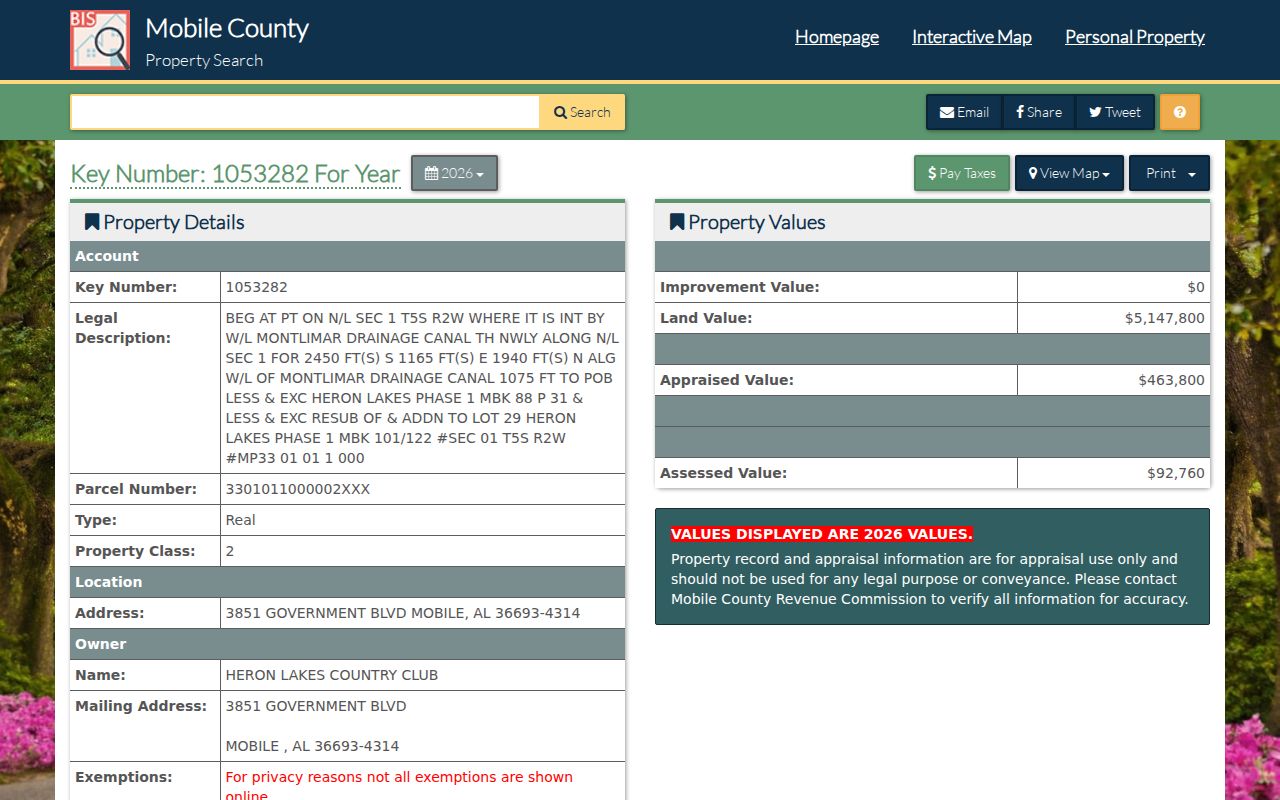
A sample card shows layout, nothing more. It cannot answer for another address. Search the intended parcel and date that result instead. Complications come quickly: percent ownership, owner ID, entity suffixes, trusts, and estates can all cloud the picture. One owner search may return several parcels or several similarly named parties, so a name match alone never settles who owns this property.
Separate Mobile County Owner Mailing and Situs
The Mobile County card shows two addresses: situs and mailing. The situs tells you where the parcel sits. The mailing line tells you where the tax bill goes. That second line may belong to an off-site owner, a company, or a fiduciary, so it never proves the named party lives at the parcel. The gap matters most for vacant land, commercial tracts, estates, and multi-parcel holdings. Preserve both fields exactly. Just label what each one means. Even when the two match, occupancy is still not established.
Mobile County Property Owner Sources
No single public screen answers every part of an ownership question. Pick the source that fits the precise claim, and attach the date plus parcel identifiers to whatever it returns.
| Source | Owner Info It Gives | Access |
|---|---|---|
| Revenue assessment card | Current-roll Name, owner ID, mailing and situs fields | Public online search; Revenue office fallback |
| Probate real-property record | Grantor, grantee, deed date, book/page or instrument | Free index account; paid image or Records Division |
| Alabama business record | Entity identity and officer, agent, or incorporator leads | Secretary of State search |
| GIS parcel layer | Parcel geometry, key, street and map-context name | County or City public map |
The Revenue name can lag a newly recorded transfer. A GIS label may reflect a different refresh date, and neither source identifies an occupant. The defensible answer states exactly what each record shows.
Confirm Who Owns With Mobile Probate Records
Mobile Probate is the recorded-instrument check. Its public materials describe real-property records from 1813 to the present. Indexes run from 1984 forward, and document images from September 1995 forward. Those ranges are not interchangeable, so note which one you need. Landmark requires an account. The index is free, while images carry a per-page charge or a subscription option. Compare the grantee, date, legal description, and any book/page reference against the parcel card. Search spelling variants too, because Probate warns that names may be indexed in different forms. For the mechanics of recorded instruments, see the Mobile County deed records guide.
Resolve Mobile County LLC or Estate Owner
An LLC or corporation on the assessment card adds a layer. The Alabama Secretary of State Government Records Inquiry System can search by entity name. It can also search by entity number. It also searches by officer, agent, and incorporator. Treat those people as leads to the entity file. They do not personally own its real estate by that fact alone. An estate can take three connected records. These are the assessment card, the probate case, and a recorded executor, administrator, or distribution deed. A will or appointment establishes authority. It does not prove a specific Mobile County tract transferred. So match the legal description in the land record itself.
Check New Mobile County Owner Deeds
A deed can reach Probate before the assessment roll catches up. County materials acknowledge that updates take time. No guaranteed closing-to-roll interval is published. That gap is why a current-roll owner and a latest-deed grantee deserve separate reporting. Treat them separately whenever they disagree. Check the tax year, the deed recording date, and the parcel's legal description. A sale, estate administration, parcel split, trust, or representative label may explain different names. Do not infer an error from the mismatch alone.
Use Mobile County Counter and Archive Routes
Digital tools sometimes fail a searcher. When Landmark access stalls, the Probate Records Division keeps public computers, microfilm, digitized holdings, and deed books. Staff are available for guidance. Deed books reach back to 1813. Real-property books begin in 1958. Staff can explain how an index works. But the rules do not require them to conduct your research for you. Counter service through Probate and Revenue, narrow inspection requests, and historical institutions all serve as fallback channels. The county's public-records form covers only records in County Commission custody. So it is not a universal title request. Aim any request at the office that actually holds the record you need.
A Probate inspection request should name the record type, the parties, and the date range. Add any book, page, or instrument number you already have. Probate's rules permit inspection of open public documents during normal hours. Sealed and confidential material stays off limits. Records remain in their division. Deposits or staff-supervision costs may apply. The rules also state that staff need not run an online search. They need not transfer electronic data on a requester's behalf either.
Stubborn historical addresses sometimes need deeper sources. The Mobile Public Library Local History and Genealogy Branch holds relevant collections. So do USA Archives, the Historic Mobile Preservation Society, the Mobile Municipal Archives, and Probate's own Archives Section. These can surface an old street form, an estate name, a ward, or a tract. Carry that clue back to the parcel, the legal description, and the recorded deed. Only then should it support a conclusion about the owner of record.
Document the Mobile County Owner Answer
A reproducible answer names its evidence. State the assessment source, tax year, search date, exact Owner Name, key and parcel number, and situs. Add matching legal-description terms. Add the newest Probate instrument found. Include its recording date, grantee, and book/page or document reference. If the deed image was not reviewed, say the result came from the index.
Keep conflicts visible. Suppose Revenue still lists a grantor while Probate shows a later grantee. The correct report is not a blended name. It is two dated findings. Add a note that Mobile County publishes no guaranteed roll-update interval. That form lets a reader recheck the evidence after the assessment record changes.
Mobile Fraud Alert and Ownership Limits
Mobile Probate offers a free Fraud Alert service. It sends notice when a recording matches a registered name. The service can help an owner watch for later filings, but it does not validate a document, block a recording, or decide who owns this property.
Redaction is separate. It is a statutory process for eligible people and information. Ordinary public owner research still rests on the available assessment and recording records.
Mobile County Who Owns Lookup Limits
A public lookup can identify a name on an assessment roll and a grantee in a recorded deed. It cannot do everything. It does not establish occupancy, resolve competing legal interests, show every unrecorded claim, or replace a title examination. GIS lines are approximate, not survey evidence.
Lawful use. Use Mobile County owner information for property research, boundary work, estate review, or purchase diligence. Never use it to stalk, harass, intimidate, or harm anyone.
Date the Revenue and Probate checks. Cite the field or instrument used, state any conflict, and prefer that measured wording over an unsupported claim of certainty.