
Compare Mobile County Property Value Types
One Revenue card can list several dollar figures side by side. Assessed value, appraisal value, and sale consideration all measure different things, so read each label and its year before treating any two numbers as comparable.
| Value | What It Is | Where |
|---|---|---|
| Appraised value | Revenue's mass-appraisal figure for the parcel | Assessment card and value history |
| Assessed value | Value after the applicable Alabama assessment level | Revenue assessment fields |
| Last sale price | Consideration reported with a prior transfer, which may need confirmation | Revenue deed-history lead and Probate deed |
| Land / improvement | Separate components that contribute to the appraisal record | Revenue parcel card |
Assessed value exists for taxation. It is no promise of what a parcel would sell for, since a deed amount can reflect family transfers or other situations that are not true open-market sales.
Apply Alabama Ratios to Mobile County Value
Alabama sorts property into classes with different assessment levels. The ratios are 30, 20, 10, and 15 percent. Applying one ratio to every parcel in Mobile County produces misleading comparisons. The property class shown on the parcel card matters so much whenever you weigh appraised value against assessed value. That is why it deserves a close look. The gap between the two figures often comes down to the assessment level alone. Exemptions and millage shape the final tax bill. Those mechanics are covered on the property-tax page.
Read Mobile County Land and Improvement Amounts
The Revenue parcel card breaks value into land and improvement entries. Appraised and assessed amounts appear there too. A zero improvement line is not proof that the parcel sits empty, so check the full card and the property context before drawing that conclusion. Keep the selected tax year attached to each component you copy down. The roll value history in the portal lets you compare dated rows, which keeps an older amount from being mistaken for a current one.
Look Up a Mobile County Assessed Value
Start from a known address or parcel. Keep enough identifiers on hand so you never compare the wrong land. Revenue's search supports address, owner, key number, owner ID, parcel number, neighborhood, property type, and tax year. That range of filters matters. A parcel number pins down one tract. The tax year keeps your assessed value current.
- Search the address in the Mobile County Revenue Commission portal.
- Confirm the key, parcel, situs, legal description, property class, and tax year.
- Read land, improvement, appraised, and assessed fields as separate values.
- Open value history and confirm any deed-history price in Mobile Probate before relying on it.
- Assessed value
- The appraised amount adjusted by the applicable assessment level.
- Appraised value
- The county mass-appraisal figure shown for the parcel.
- Assessment ratio
- The class-based percentage used to derive assessed value.
- Consideration
- An amount associated with a recorded transfer, not always an arm's-length price.
Interpret Mobile County Roll Value History
Roll value history breaks each year into its own row. Land market, appraised, and assessed figures sit side by side. That layout makes it easy to spot when one component moved while another stayed flat. A jump can show in the land market figure. It can land in a year when the assessed value barely budges.
Keep in mind what this record is. It is a government assessment record. It does not chart actual offers or closed market sales.
Copy the field label exactly as the roll prints it. "Land market" is not total market value. A partial row is not a complete annual record. Treating either one loosely distorts the history.
View Mobile County Assessed Value Rows
The official Revenue sample's value section lays out land market, appraised, and assessed entries in rows organized by year.
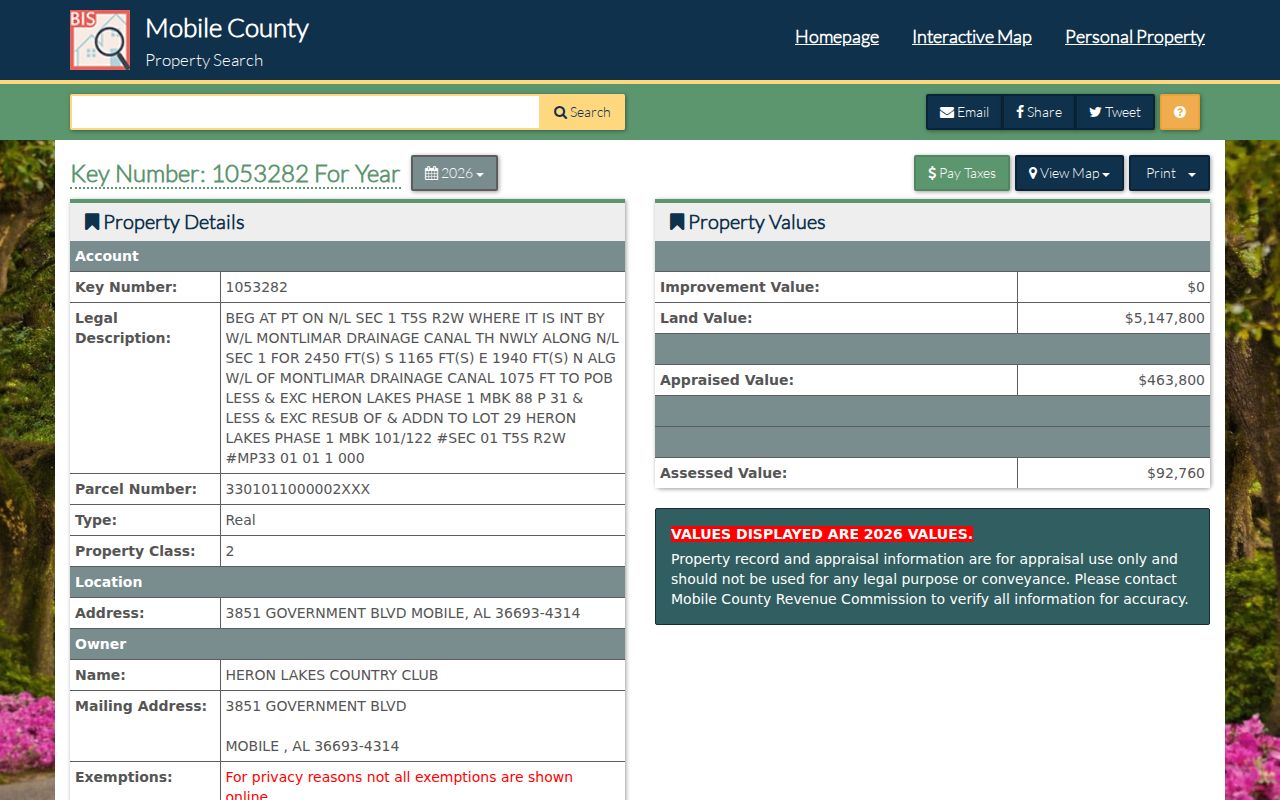
The sample only explains the interface. A real property value statement must come from the subject parcel's current card, with unlike measures kept apart.
Confirm a Mobile County Recorded Sale Amount
The Revenue deed-history section lists several key fields. These include deed date, deed type, sale price, grantor, grantee, sale type, and instrument number. Some entries run thin. Pull the legal description and reference book and page. Then confirm the actual instrument in Mobile Probate before trusting any figure. A zero-dollar amount is rarely a true price. It may mark a non-market transfer, an estate step, a correction, or an incomplete display. Report what you see as recorded consideration unless the source clearly supports more.
Keep Exemptions Outside the Core Value Comparison
Revenue states plainly that not all exemptions appear online, for privacy reasons. That matters. An exemption can move taxable value, or the whole tax bill, without touching the appraisal field underneath. Never back-calculate a market value from a tax payment. For exemptions, millage, payments, and appeals, the Mobile County property tax records guide goes further. This page stops at what the value numbers mean.
Add Mobile County Value Map Context
Flood, zoning, subdivision, historic, annexation, and land-use layers can explain why two Mobile County parcels differ. None supplies an automatic adjustment to value. GIS boundaries are approximate at best. They are not survey or appraisal products. Keep the map layer and its date as context only, and never let a color, overlay, or municipal label stand in for a supported dollar conclusion about a parcel.
Compare Mobile County Values Across Years Fairly
Check before comparing two annual rows. Confirm the parcel identity, property class, and field label stayed the same. A split, merger, exemption, classification change, or partial row can turn a simple percentage change into nonsense. Keep land, improvement, appraised, and assessed figures in separate columns. The sample Revenue card shows land market shifting. Displayed appraised and assessed values hold level across several rows. That pattern is a prompt to inspect the complete Mobile County property record. It is not evidence of a countywide rule. State only what the subject parcel's dated history supports.
The sample record as a field schema
A parcel card in Mobile County packs in a lot: property class, land and improvement values, appraised and assessed amounts, taxing-jurisdiction rows, roll value history, deed history, payments, exemptions, and a map link. Those fields reveal how the county organizes a property record. They prove nothing about any other parcel. A different parcel may carry different components or a different valuation pattern entirely.
One caution appears on the sample itself. Some exemptions are withheld from the online record for privacy reasons. So an apparent mismatch between assessed value, taxable value, and a payment is not something to fix by guesswork. Write down the exact labels shown, and take bill or exemption questions straight to Revenue.
Recorded consideration versus market evidence
A deed record can show a zero price. It can show a blank. It can also show a number tied to something other than a normal market sale. Some transfer fields run thin. Read the deed at Probate first. Check the deed type, the parties, the consideration language, and the legal description. Only then treat the amount as meaningful. A recorded price also describes a single past event. It may cover multiple parcels, a family or entity transfer, or other terms a portal field never captures. Keep it as a recorded-sale reference. Keep it separate from assessment values and from any opinion of what the property is worth today.
Property class stays in the calculation
Alabama applies four assessment levels, one for each property class. Classification is evidence, not a footnote. Note the class on the subject card. Test whether the assessed figure lines up with the appraised amount. Do not use the assessment ratio to back into a sale estimate. The ratio explains an assessment record used in taxation. Millage, exemptions, estimated tax, delinquency, and appeals come later. Each has its own records and rules.
Report Mobile County Property Value by Year
A useful value note has four parts. List the parcel identity, the value label, the amount, and the year. Add the property class whenever the discussion turns to assessed value, and cite the deed separately when citing a prior price.
| Claim | Required context | Safe description |
|---|---|---|
| County appraisal | Tax year and parcel | Appraised value shown by Revenue |
| Assessed figure | Class and assessment level | Assessed value for that roll |
| Transfer amount | Deed date and instrument | Recorded or displayed consideration |
This format makes comparisons possible without merging distinct measures.
Understand Mobile County Property Value Limits
The Revenue figure is appraisal information for assessment purposes. It cannot promise a sale price, replace an appraisal prepared for a specific purpose and date, or settle the legal condition of title. A past deed amount does not predict a current offer either.
Value is not price. A Mobile County assessed value is for taxation and is not what the property would necessarily sell for. It is not an independent appraisal.
Date every value and keep official fields separate from outside market indicators. That discipline keeps the record clear without overstating what it can tell you.