
Verify the Mobile County Current Owner Record
The Mobile County Revenue Commission lists the assessed owner under the Name: label on each parcel's record. When you verify a current owner, keep the parcel number and tax roll details with the note. That way the record stays tied to the exact Mobile County property it came from.
| Owner > Name | The current assessment-card name |
|---|---|
| Tax Year | The selected roll year supporting the finding |
| Mailing Address | Where assessment correspondence is directed |
| Situs Address | The physical location of the parcel |
| Key and Parcel | Identifiers used to prevent a false match |
| Legal Description | The recorded land description to compare |
Quote that entry as the owner shown on the current assessment card. Save the tax year too. Date the lookup, since Revenue describes its online data as appraisal information rather than official legal or conveyance documentation.
Match Mobile County Current Owner Parcel
One common name can sit on several cards. One owner can hold several parcels. Before naming a current owner, compare the key number, Parcel Number or GeoID, situs, and legal description. Check the neighborhood and property type as well. The portal offers address, owner, and ID search modes. These are simply three routes to the same parcel identity. A legal description matters most where street labels have changed. It also matters when lots have split or merged. The situs orients the property search, but it is not the land's full recorded description.
Date the Mobile County Owner-of-Record Finding
The Revenue portal offers multiple tax years. An older year is not a present result. Record which year you selected. Record the access date as well. Mobile County materials acknowledge that updates take time, though no fixed closing-to-roll interval is promised. So a newly recorded deed can appear in Probate before the assessment name catches up. Keep both dates, describe the gap, and treat neither source as timeless.
See Mobile County Current Owner Context
The Revenue Commission sample parcel card shows the Owner Name beside the parcel's other identity and value sections.
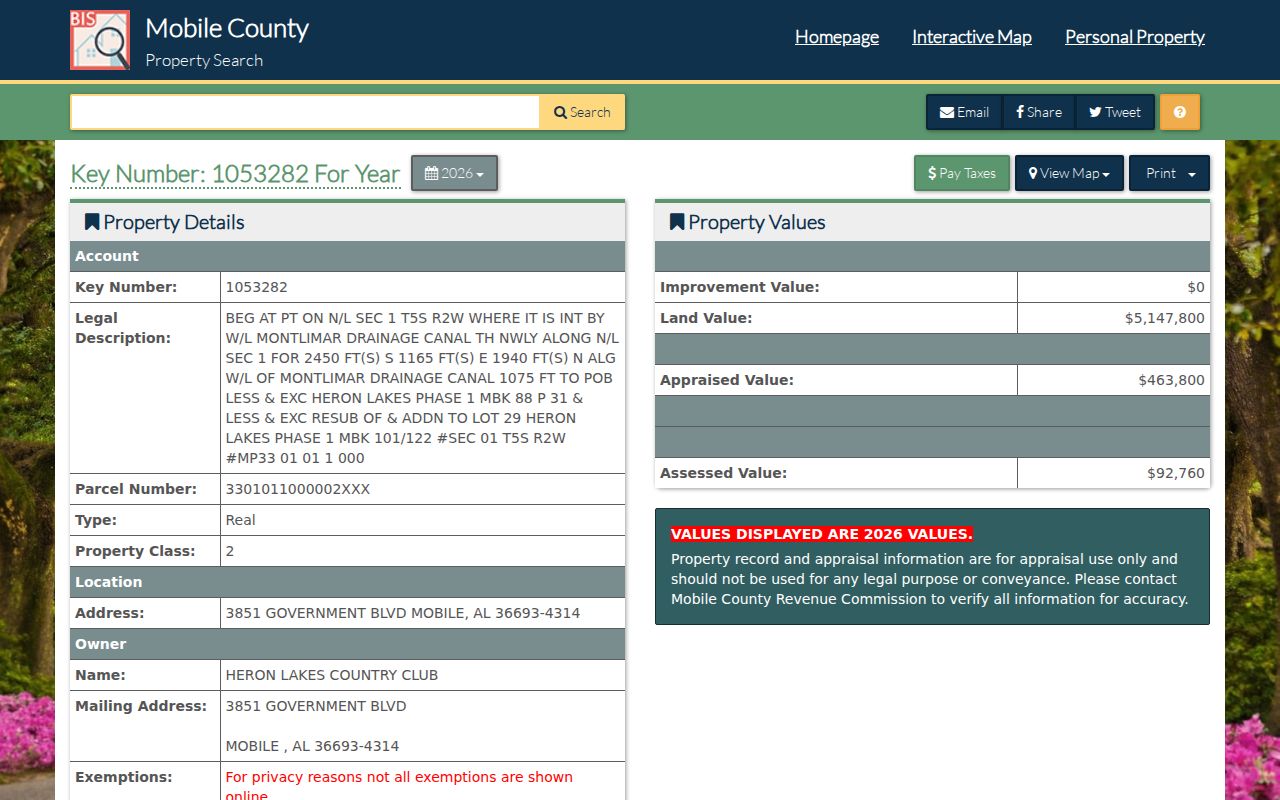
That view reflects the interface and one sample record. A live current-owner search must open the subject parcel itself and keep its own date and identifiers.
Separate Mobile County Mailing and Situs Fields
The situs is the property's physical location. The mailing address is where notices go. It may belong to an off-site owner, an entity office, or a fiduciary, and it never proves residence or occupancy.
Record terms. Owner of record means the name on the dated assessment card. A grantee receives an interest under a deed. Vesting describes how title is held. A registered agent receives entity notices but is not automatically the landowner.
Confirm Mobile County Current Owner in Probate
Check the assessment name against the newest matching instrument in Mobile Probate's Landmark WEB index. Compare grantee, recording date, and legal description, not just a similar name.
- Read Owner > Name, tax year, key, parcel, situs, and legal description in Revenue.
- Locate the latest Probate instrument that matches the same tract.
- Compare its grantee and recording date with the current assessment card.
- Document a difference and ask the proper custodian when it remains unresolved.
- Owner of record
- The name shown by a specified public record on a stated date.
- Vesting
- The deed language describing how an interest is held.
- Registered agent
- An entity contact, not proof of personal ownership.
Read Mobile Probate's Coverage Dates Carefully
Probate advertises real-property records from 1813 to the present. Indexes run from 1984, and document images from September 1995. Those are three separate coverage claims. Landmark registration is required. The index is free, while images carry a per-page or subscription cost. When an online image is missing, the Records Division offers public computers. It also provides digitized holdings, microfilm, and copy routes. That fallback matters more than assuming every old deed is freely viewable online.
Interpret Mobile County Entity Owner Names
An LLC or corporation on the card is the listed current owner. Alabama's Secretary of State search can identify the entity by name or number. It can also surface officer, agent, or incorporator leads. It does not make any of those people the property's owner. A trust or estate may show a fiduciary role instead. Probate-case authority and the land instrument are distinct records. Confirm any transfer against the deed and legal description.
Check Shared Mobile County Ownership Interests
Revenue results can include percent ownership, owner IDs, and multiple names. Copy every displayed interest rather than picking a favorite. The deed may state the vesting more precisely. Reading its legal effect can call for professional title review. Neutral labels keep the answer useful. Say "Revenue lists" for the assessment roll. Say "the latest deed names" for the recorded grantee.
Use Mobile County Current Owner Fallbacks
When an online result is unclear, split the question by custodian. Revenue keeps the assessment name, key, parcel, and value record. Probate keeps the recorded deed and its image. Public computers and the Records Division help when Landmark does not deliver a document online. A narrow request beats asking an office to run a title search. Give the situs, key or parcel, owner spelling, date range, and any known instrument reference. County Commission records requests do not replace Probate's own inspection and copy routes, and staff are not required to reach an ownership conclusion for a requester.
Result context to retain
Revenue gives you three ways to view results: grid, list, or map. A grid row can carry a lot of detail. Expect fields like key number, year, parcel number, neighborhood code, and property type. Owner Name, owner ID, situs, legal description, appraised value, street fields, DBA, subdivision, and percent ownership also appear. Dynamic fields do not all appear on every result, though. The compact row is a starting point. Open the parcel card before treating anything as the full ownership record.
Row controls help too. The portal offers 25, 50, or 100 rows per page. It caps CSV download at the first 500 results. Those limits matter when a common owner name pulls up dozens of parcels. Narrow your property search by tax year, key, parcel, neighborhood, or situs. That way the result you pick matches the right land rather than the first name that happens to match.
Deed comparison to preserve
Pull a deed from Mobile County Probate and record the details that anchor it. Save the deed date, recording reference, deed type, grantor, grantee, and legal description. Try spelling variants as well. Probate itself recommends testing every plausible form of a name. A thin deed-history row on the Revenue side is only a lead to that record. It is never a substitute for the deed itself.
Landmark's published materials describe a database of more than five million documents. The property records, the index, and the images each carry different starting dates. That scale argues for care. Name the exact collection behind any ownership claim. Say "latest deed in the index" rather than "absolute legal owner." The narrower phrasing is the honest one.
Build a Mobile County Present-Owner Evidence File
Order the file parcel first, roll name second, deed comparison third. Keep it compact. Note the access date too, so the result can be rechecked after the next update.
| Question | Field to retain | Result language |
|---|---|---|
| Which land? | Key, parcel, situs, legal description | Matched assessment unit |
| Who is on the roll? | Owner Name and tax year | Current-roll name |
| What deed is newest? | Grantee, date, book/page or instrument | Latest matching recording located |
A card-centered file like this stays focused on the present owner. It also sets this page apart from the wider question of how to find who owns Mobile County property.
Limits of a Mobile County Current-Owner Result
A current-owner result shows what a named source displayed on a given date. It proves occupancy of nothing. It cannot reveal every unrecorded claim. It cannot settle competing interests or replace a title examination. The mailing address field can support property correspondence, but it is not the situs.
Use owner data with care. Mobile County records support property diligence and civic research. Never use a listed name or mailing address to stalk, harass, intimidate, or harm anyone.
The strongest present-tense answer names the source, the tax year, the search date, and the deed comparison. Anything more overstates what the records establish.