
Reading Mobile County Property Tax Records
The Revenue parcel card pulls together facts from separate stages of the tax process. Identity fields locate the account. Value fields show the appraisal and assessed base. Jurisdiction rows apply the millage. Exemption and payment sections explain relief and collection. Treat the card as appraisal information only. It can change, and it is not legal conveyance documentation. So a deed question needs the deed records rather than the tax roll.
| Field | What It Shows | Where |
|---|---|---|
| Appraised value | Revenue's appraisal amount for the selected year | Parcel card and value history |
| Assessed value | Value after the Alabama class assessment level | Parcel card and roll history |
| Exemptions | Relief applied to qualifying property, with privacy limits online | Exemption section and Revenue office |
| Tax jurisdictions | Entity, millage, taxable value, and estimated tax by row | Jurisdiction table |
| Payment history | Payment date, year, payer, and amount | Parcel card payment section |
Alabama assigns each property class an assessment level of 30, 20, 10, or 15 percent. Confirm the class first. Only then multiply. A recorded sale price belongs to a conveyance event in the deed records, while the tax bill reflects assessment, taxable value, exemptions, and the millage that applies.
Mobile County Tax Search Fields
The Mobile County Revenue property search offers owner, address, ID, and advanced modes. Pick the tax year deliberately. The portal covers 2026 back through 2008. If an exact street number fails, try a simpler street name and narrow by key or parcel once the right result appears.
| Mode | Inputs | Tax use |
|---|---|---|
| By Address | Street number, street name, neighborhood | Find an account from the situs |
| By Owner | Owner name, doing-business-as name | Find assessed accounts tied to a name |
| By ID | Key number, owner ID, parcel number | Return to one known account |
| Advanced | Property type, tax year, parcel, hearing and board fields | Narrow specialized roll results |
Results can display as a grid, a list, or a map. Page sizes run 25, 50, or 100. CSV download stops at the first 500 results. A broad Government Street search can return a block-sized list. Save the key and parcel for later visits. The official Revenue portal landing screen shows where each search mode begins.
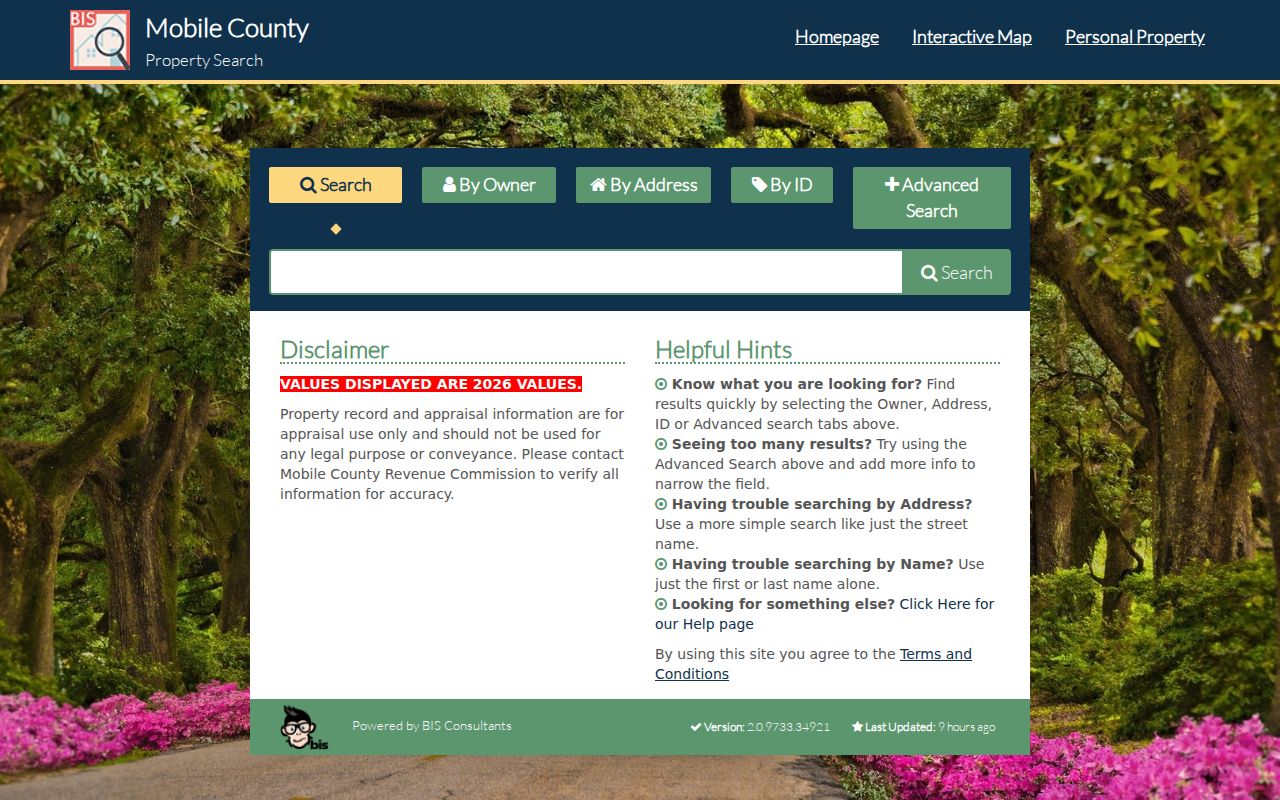
The image confirms the county search route. Still check the tax year on any live result before quoting figures.
Looking Up a Mobile County Tax Bill
Keep the assessment layer and the payment layer side by side without merging them. Start with the physical address. Confirm the legal description and parcel identifiers next. Then read every jurisdiction row for the chosen year, because one visible school row is not the full county bill.
- Search by situs address. Open the likely card and confirm key number, parcel number, owner label, and full legal description.
- Select the intended tax year. Read appraised and assessed values, then inspect each jurisdiction row and its taxable value.
- Review exemptions and payment history. Contact Revenue when privacy limits hide an exemption or a recent payment has not posted.
- If delinquent, distinguish unpaid tax, auction listing, lien certificate, redemption, foreclosure action, and any later deed.
- Assessed value
- The appraised amount adjusted by the statutory class assessment level.
- Millage
- A tax rate applied to taxable value by a listed jurisdiction.
- Homestead exemption
- Relief for qualifying owner-occupied property, subject to application and eligibility.
- Tax lien
- A priority claim securing delinquent property taxes, costs, and related charges.
Mobile County Property Tax Value History
Value-history rows sit on the parcel card. They separate improvements, land market, appraised, and assessed values by year. Labels matter here. On a sample card, land market shifted. Appraised and assessed figures held flat across several displayed years. No single column is the property's sale value. The sample Mobile County value view shows the layout behind this comparison.
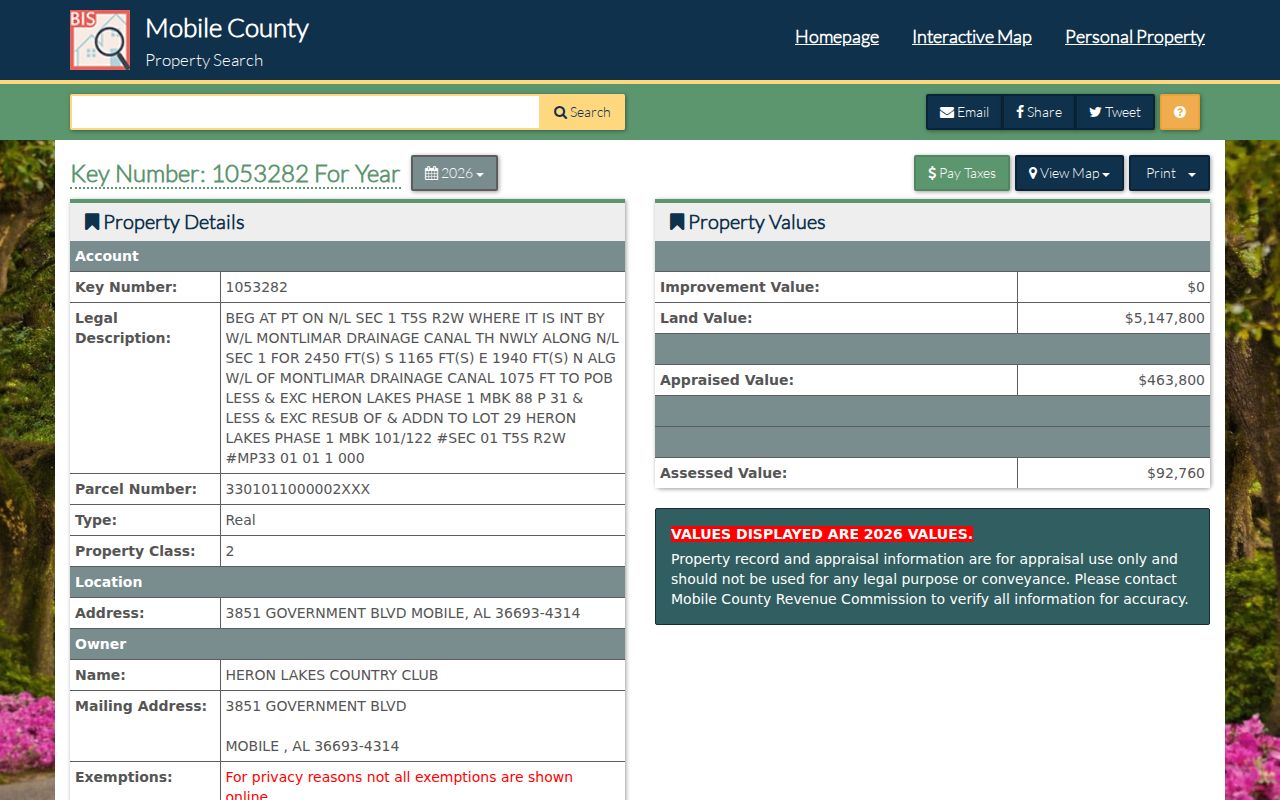
The image illustrates field structure, not a countywide benchmark, so compare the same parcel and class across years.
Mobile County Exemptions and Online Privacy Limits
Revenue administers property exemptions. The parcel card warns that not all exemptions appear online for privacy reasons. A blank public section is not proof that no relief applies. When an exemption question affects a bill, contact the Revenue Commission with the key, parcel, owner-of-record details, and tax year. Keep value disputes with the Board of Equalization. Exemption eligibility, tax amounts, and miscellaneous fees belong to other offices. Route each issue where it can actually be changed. Don't treat the appeal process as a general tax complaint.
Mobile County 2026 Tax-Lien Auction
Property taxes are due October 1 and turn delinquent if unpaid before midnight December 31. For the 2026 cycle, official Mobile County material listed a May 11 online auction of 2025 delinquent-tax liens. It also listed list publication by March 30 and registration opening April 6. A 10 percent deposit applies. The auction list carries owner names and a property description. It also shows delinquent years and amounts with interest, penalties, fees, and costs. It may lack a useful street address. Match entries back to Revenue by owner, key, parcel, and legal description. The winning bidder receives a tax-lien certificate, which remains subject to redemption.
A lien certificate is not title. Mobile County states that purchase does not transfer possession, profits, right of entry, or ownership and does not erase easements or covenants.
Mobile County Tax Payments and Receipts
The Revenue card's payment history shows the payment date, tax year, paid-by text, and amount. A separate receipt search handles receipt work. Always align the payment year with the bill year, since a calendar-year payment can settle a prior tax year.
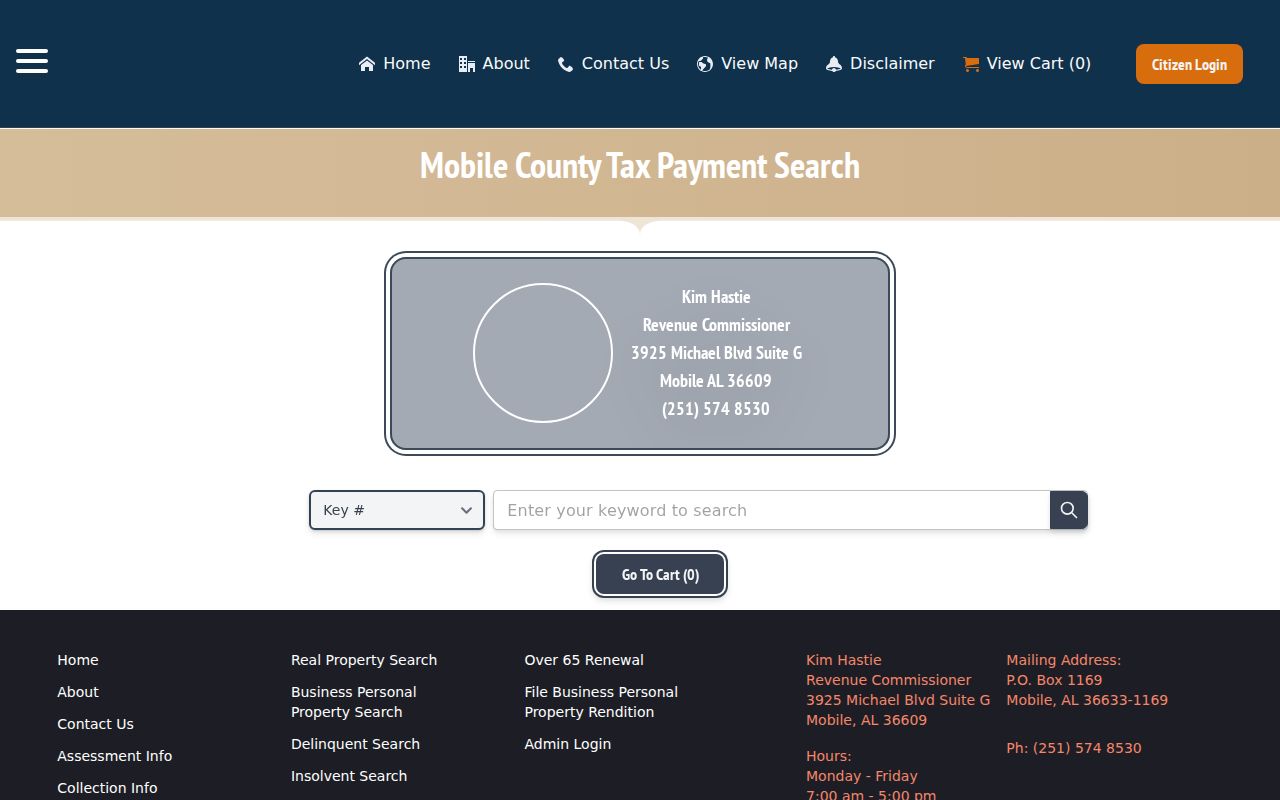
The receipt screen is a collection record. The parcel card remains the place to compare the ownership label, assessment, jurisdictions, and value history.
Mobile County Tax Jurisdiction Rows and Millage
Each jurisdiction row is one component of the estimate. The table identifies the entity, description, millage rate, taxable value, and estimated tax with exemptions. A sample school row showed 14 mills. But that single line cannot be extrapolated into the parcel's full liability. City, county, school, and other rows differ by location and year. Confirm the situs sits inside the jurisdiction shown for that tax year. This matters especially near Mobile, Prichard, Saraland, or an annexation boundary. A postal city proves nothing about a municipal tax boundary. If a district line looks stale, save the parcel key, year, and displayed row. Then ask Revenue to verify the roll.
Mobile County Tax Office Follow-Up
You can reach the Revenue main office at 3925 Michael Square, Suite G, in Mobile. General calls go to 251-574-4714 or 251-574-8530, and appraisal questions go to 251-574-4721. One caution before you drive over: the current homepage says every office closes on Wednesdays, and it lists a temporary satellite-office closure in 2026. Checking hours ahead of any visit saves a wasted trip.
Gathering the right details first makes each stop count. Bring the key, the parcel number, the situs, the owner label, and the tax year. Then match the question to the right office. Probate handles deeds. The Board of Equalization takes a timely value protest. Revenue covers assessment, exemption, payment, and redemption questions. If redemption has moved into a foreclosure action, the Circuit Court is the office to see.
Parcel Identity on Mobile County Tax Records
A year-to-year tax comparison only holds up when every row belongs to the same land. Revenue shows a key number plus a separate parcel number or GeoID. It also lists the owner label, physical situs, mailing address, class, and legal description. The Board's protest form uses a punctuated full-parcel pattern. A public card displays a compact version. Keep each label and format intact. One identifier will not work in every search field. The situs marks where the assessed property physically sits. The mailing address, by contrast, is simply where the tax notice goes. It may belong to an entity, a fiduciary, an agent, or an owner far away. Neither address proves occupancy. When an old street number, a split parcel, a same-name owner, or a subdivision phase muddies the picture, lean on the legal description. Keep the chosen tax year beside every amount you copy.
Mobile County Tax-Lien Redemption Records
A delinquent-tax inquiry does not end at the auction. The lien certificate spells out the property description, the auction date, the lien holder, the assessment year, the taxes and charges covered, and the interest rate. Redemption may still be open before a foreclosure judgment. It can extend to the owner, heirs, a personal representative, a mortgagee, a purchaser, or anyone else holding a legal or equitable interest under the county's stated route. Expect the total to combine certificate debt, interest, qualifying costs, and a redemption fee. Once an action under Alabama Code §40-10-197 begins, redemption moves to Mobile Circuit Court. Probate may hold notices, releases, lis pendens, or related instruments. Search every office with the same parcel and legal description. Delinquency, the lien certificate, court action, redemption, and later conveyance are separate events. Check current law and office instructions before committing funds.
Dates That Control Mobile County Tax Research
Keep each date in its own field. October 1 is the lien and valuation date. December 31 marks the delinquency cutoff. The parcel-card tax year, the payment date, the appeal deadline, the auction date, and the deed recording date each describe a different stage of assessment and collection, so a later payment never rewrites the valuation date, and an auction notice does not establish a conveyance. That date discipline also makes any office follow-up far easier to reproduce.
Appealing a Mobile County Assessment
The Mobile County Board of Equalization hears fair-market-value protests. The 2026 form required the key, full parcel number, the owner's opinion of value as of October 1, 2025, reasons, an original signature, contact details, and agent authority when someone else filed.
2026 appeal deadline. The Board listed May 19, 2026. Filing was permitted by hand, mail, or email, but not fax, and evidence was not returned.
The Board decides value questions only. Whoever was the owner of record at the lien date must file. If that person cannot, they may formally authorize an agent. Evidence should track the value date. Bring comparable sales, photographs, repair estimates, an appraisal, maps, and any other parcel-specific support. Frame a protest carefully. Before you do, the Mobile County property value guide sorts out assessed, appraised, and sale amounts.