
What Mobile County Deed Records Show
A recorded deed tells you who signed, what interest moved, when the instrument dated, and where it was filed. Mobile County Probate holds far more than deeds. Its shelves include mortgages, liens, lis pendens, maps, condominium books, tax-sale books, and judgments. Some of these instruments touch a parcel without transferring ownership. So read the document type first. A name alone does not build a chain.
| Deed Type | What It Does | Common Use |
|---|---|---|
| Warranty deed | Conveys the described interest with stated title promises. | An arm's-length real estate transfer. |
| Quitclaim deed | Conveys whatever interest the grantor holds without broad promises. | Family transfers or correction of an interest. |
| Executor or administrator deed | Conveys property through an authorized estate representative. | A transfer connected to probate administration. |
| Mortgage | Records a security interest rather than a change of owner. | Financing and later release research. |
| Tax-related instrument | Documents a lien, certificate, redemption, or later conveyance. | Tracing delinquent-tax events without assuming title passed. |
A mortgage or lien is an encumbrance, not a deed. The same caution applies to the 2026 Mobile tax-lien auction, which yields a certificate subject to redemption rather than an automatic transfer of title. Read the instrument itself and its legal description before naming the event.
Mobile County Probate Coverage Dates
The Probate Records Library organizes its real-property material by collection instead of promising one continuous online run. Property records date from 1813, real-property books from 1958, indexes from 1984, and document images from September 1995. Separate deed books span 1813 through 1958. Mortgage books run from 1851 through 1958.
| Record run | Stated coverage | Best route |
|---|---|---|
| Deed books | 1813-1958 | Records Division, digitized microfilm, and archival holdings |
| Real-property books | 1958-present | Landmark and Records Division |
| Real-property indexes | 1984-present | Landmark account search |
| Real-property images | September 1995-present | Paid image access or office copy |
Those date lines matter in practice. A name can sit in an older book even when no image is available through the modern route. A missing online image, in other words, does not mean the Mobile County deed was never recorded.
Entering Mobile County's Landmark Deed Index
The Probate Records Search page routes searchers into Landmark WEB. Registration or logon is required before any query runs. The land-record index itself is free. Document images carry a per-page charge unless you hold a subscription. Before login, the portal posts a disclaimer you must accept. It also advises trying every spelling variation of a name.
| Visible control | Format | Practical meaning |
|---|---|---|
| User Name | Required text, 1-50 characters | Landmark account credential |
| Password | Required password, 1-100 characters | Account access |
| Search menu | Disclaimer before search | Accept terms before the index opens |
| Register New Account | Account setup | Creates access to the free index and paid images |
Once logged in, expect search controls built around grantor, grantee, document type, and date, though the exact field list appears only inside an active session. The Landmark search route stands at that public session boundary.
Confirm the available fields on the live page rather than assuming them.
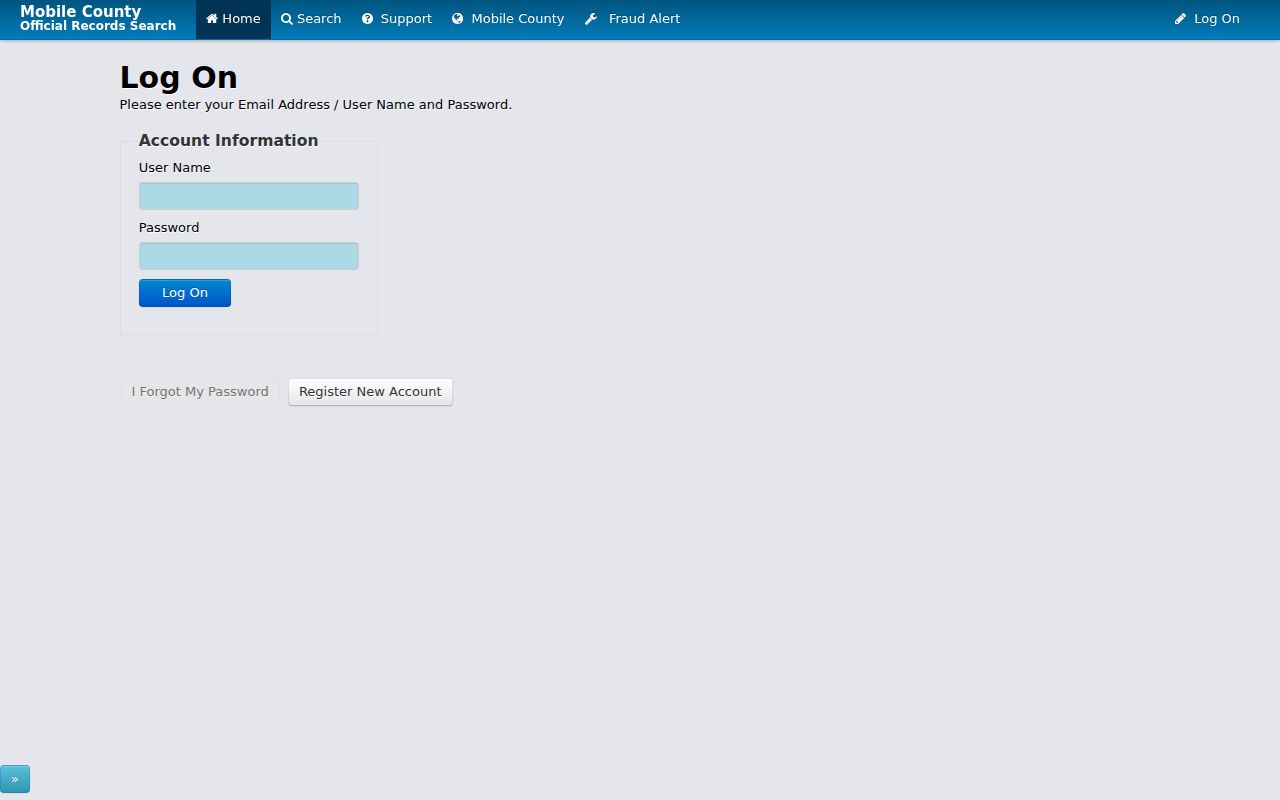
The portal and its access gate are visible up to the login. What lies behind the accepted session stays unseen until you are inside it.
Walking the Mobile County Grantor-Grantee Trail
A chain search runs backward from a current instrument. The Revenue parcel card can hand you a deed date. It can also supply a deed number as a starting clue. But the Mobile County deed image and its legal description should control each next step. Match the parcel by subdivision, lot, section-township-range, map book, or metes-and-bounds language. Never match by surname alone.
- Find the present owner's acquiring deed, with that owner normally indexed as grantee. Copy the recording date and book/page or document reference.
- Read the grantor and full property description in that deed. Confirm that the land, not just the party name, matches the subject parcel.
- Search the grantor as a grantee in an earlier period. Repeat the comparison of names, dates, interests, and legal descriptions.
- When Landmark coverage stops, carry the last firm name and reference to the direct and reverse indexes, deed books, microfilm, or archive.
- Grantor
- The party conveying the stated interest.
- Grantee
- The party receiving the stated interest.
- Chain of title
- The linked sequence of recorded transfers affecting the same land.
- Book/page
- A volume and page reference used to locate an older or imaged record.
- Instrument number
- A distinct recording identifier that should be preserved exactly when shown.
Older Mobile County Deed Books
Mobile County keeps an unusually long paper trail. The Judge of Probate has been custodian of these records since 1812, according to Probate. The state archives first sent a microfilm team to Mobile in August 1948. Probate opened its Micrographic Section in 1958. Digital scanning followed in 2000. eRecording arrived in 2014. Microfilm images with direct and reverse indexes were digitized in 2019.
The archive itself dates to 1989. It was created after colonial and historic records turned up in a courthouse attic. Its holdings span translated records from 1715 through 1841. These include Spanish and French material, township maps, early plats, St. Stephens Meridian files, Corps of Engineers surveys, original wills, and old tax and road records. When a modern parcel number cannot answer a question, these sources can supply former place names or boundary language.
Note: Mobile County reports no deed-year loss from a courthouse fire. Treat a missing result as missing rather than destroyed.
Plats and Easements Beside Mobile County Deeds
Map books in the Probate inventory run from 1872 to the present. A deed may cite a subdivision, phase, lot, resubdivision, or map-book page instead of describing every line itself. The plat can also show easements, dedications, rights-of-way, setbacks, or common areas. The Revenue card never repeats those details.
Treat the legal description as the bridge between deed and plat. A road, drainage feature, cemetery edge, railroad, or private lane may appear on the ground or on a map. Pull the referenced plat and any recorded instruments before settling a boundary question. The Mobile County parcel map guide shows how GIS works for orientation. Survey questions stay with the recorded plat and a licensed surveyor.
Mobile County Recording Counter and Copy Channels
The Recording counter sits on the first floor of the Mobile County Government Center Annex at 151 Government Street, open weekdays from 8 a.m. to 5 p.m. The Records Division provides public computers and staff assistance with the collection. Staff do not have to run a search for you. Mail and inspection requests still work well when an online image is missing.
Probate Records Division
151 Government Street, Mobile
Records: 251-574-6070
Recording: 251-574-6040
Landmark WEB
Free account index
Paid document images
Plain and certified office copies
The public fee schedule prices online images at $0.10 per page with ten-day download or print access, a monthly subscription at $125, counter copies generally at $1 per page, and certification at $2. Recheck fees before ordering a large set.
Mobile Probate Fraud Alert and Name Variants
Mobile Probate runs a free recording alert program. Anyone can submit the Fraud Alert form with a personal or business name and an email address, then confirm through a link sent to that inbox. Because the system matches against indexed names, Probate suggests enrolling every plausible spelling or name variant so nothing slips past the watch.
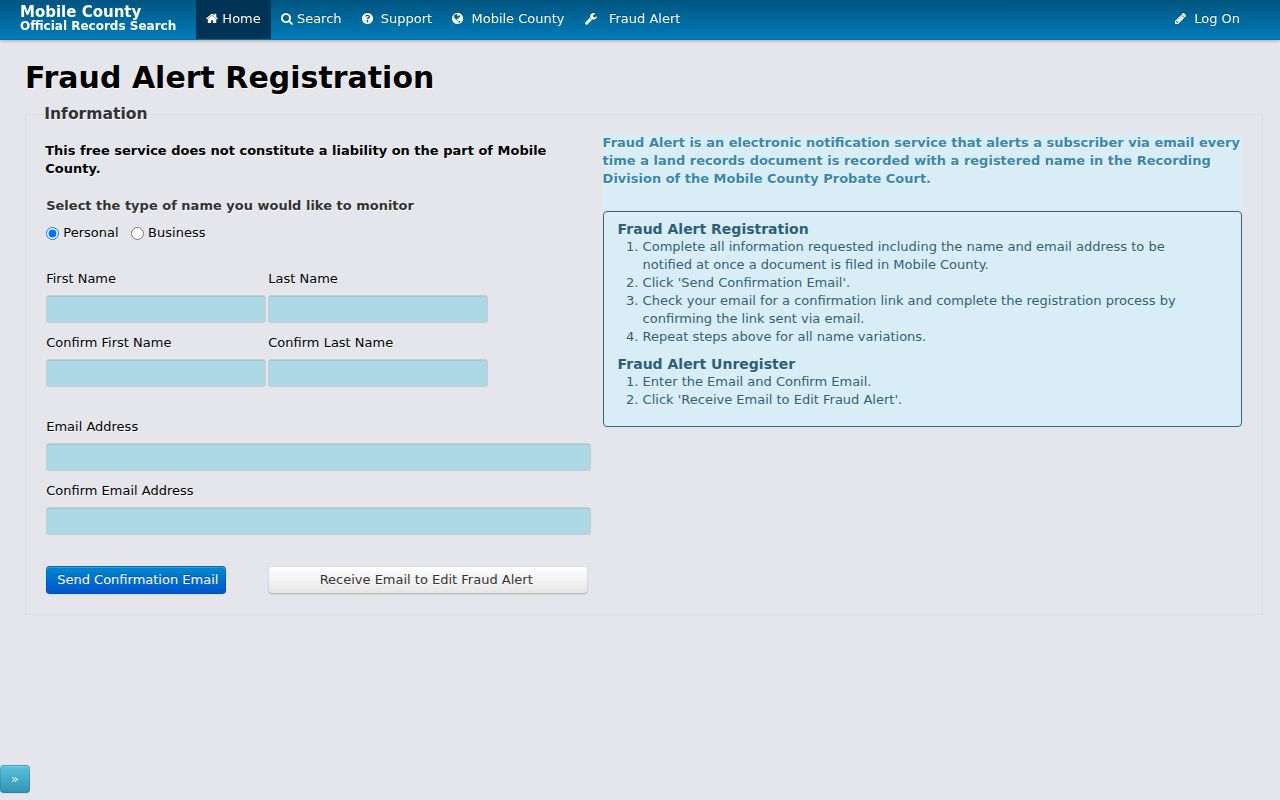
The alert only notifies. It cannot stop a recording from being filed, and it cannot fix a deed already on file. Redaction under statute is a separate process with its own eligibility rules.
Mobile County Deed References on Revenue Cards
Each Revenue parcel card carries a Property Deed History table. Columns cover the deed date, deed type, sale price, grantor, grantee, sale type, and reference number. Think of it as a bridge into Mobile County deed records rather than a stand-in for the recorded image itself. One example card lists a September 18, 2001 deed dated, a zero-dollar entry, a Land label, and reference 5041-817, with several party and type cells left blank.
Treat every row as a lead, not a conclusion. Copy the reference exactly, pull the Probate instrument, and check the full legal description against the card. A zero sale amount may say more about how the event was keyed in than about any market price. A blank cell does not mean the deed is missing that detail. For a reliable chain of title, the recorded image supplies the authoritative text.
Mobile County Deed Inspection Routes
When Landmark does not have the image, Mobile Probate's Records Division is the fallback. The inspection process covers the rest. A tight request should state the record family and the party names. It should also include the date range and any known book/page or instrument number, plus the property description. Staff can walk you through the index and collections. Published rules are clear, though: they will not perform research or indexing on a requester's behalf. Records are not delivered by electronic data transfer.
Inspection stays under office controls. Sealed, confidential, court-restricted, or protected material can be withheld, and nothing leaves the division. Copy fees, deposit charges, or staff-supervision costs may apply. Before visiting with early deed books, maps, archives, or microfilm, call ahead. That way the right collection and access channel can be sorted out.
Getting a Mobile County Deed Copy
Match the copy type to the purpose. A paid online image is the easy route for reading parties and legal descriptions. A plain office copy often serves working research fine. When an agency, court, or transaction demands a certified record, ask Mobile Probate for certification. Include the exact book/page or instrument reference, the record type, party names, and date. That way false matches stay out of the results.
Recorded is not the same as guaranteed. Mobile County deed records show filed instruments, not a title opinion. Unrecorded interests, indexing errors, releases, court orders, or competing descriptions may require professional title review.
Work in sequence for the cleanest request. Locate the index entry, verify the description on the image, note any related references, and order certification only for the final instrument you truly need. For a longer ownership history, the former-owner chain method beats ordering scattered name matches.