
Start a Mobile County Property Search
Your starting clue picks the door. An address or street name goes straight into the Mobile County Revenue property search. The parcel card lists the county key and parcel number. It also shows the situs, owner label, legal description, values, and deed-history references. A book and page, instrument, grantor, or grantee belongs in Mobile Probate's recorded-document system instead. An owner name works in either place.
No single result is the whole file. Revenue data is appraisal information, not proof of legal conveyance. Probate shows what was recorded, and GIS offers only an approximate spatial view. Match the parcel key and legal description. Then match the names, dates, and recording reference before you draw a conclusion.
- Search Revenue by situs address or a simple street name.
- Open the parcel card and save its key, parcel, owner label, legal description, and tax year.
- Use a deed-history clue or party name in Probate's Landmark WEB index.
- Compare the parcel in county GIS and inspect its plat when lines or access matter.
- Request an official or certified copy when the record will support a formal decision.
Mobile County Property Record Keepers
Mobile Probate serves as the county's recorder. It holds deeds, mortgages, plats, liens, lis pendens, tax-sale books, and recording indexes. The Revenue Commission keeps the appraisal and tax parcel cards. County GIS hosts the Researcher Map. City offices add zoning, permits, annexation, and historic review. They never replace county title or assessment sources for a Mobile County property search.
Mobile Probate Records Division
151 Government Street
Mobile, AL 36602
251-574-6000
Mobile County Revenue Commission
3925 Michael Boulevard
Mobile, AL 36609
251-574-8530
Mobile Probate Records Through Time
Coverage in Mobile Probate depends on format and era. Deed books run from 1813 through 1958. Mortgage books span 1851 through 1958. Real-property books carry 1958 forward. The real-property index is advertised from 1984, and online images begin in September 1995.
The Records Division is the fallback. It holds older books, microfilm, direct and reverse indexes, and archive holdings. Probate digitized its microfilm and name indexes in 2019. It does not promise that every image is freely online. Bring staff the names, variants, date range, book or map clues, and legal description.
Note: Landmark registration is required; its index is free, while document images may carry page or subscription charges.
Read a Mobile Revenue Card
The exact Name: field identifies the owner carried on the assessment roll. Situs is simply where the property sits. Mailing address is the notice destination. It may belong to an agent, entity, or fiduciary. Key number and parcel number are separate identifiers. Neither matches a City GIS KEYX value.
| Name and owner ID | Current-roll ownership lead |
|---|---|
| Situs and mailing | Physical site versus notice destination |
| Key and parcel | Identifiers used to narrow the match |
| Legal description | Subdivision, lot, map book, or survey clues |
| Values and history | Tax-year value, deed, and payment fields |
A single official sample parcel card holds all these labels.
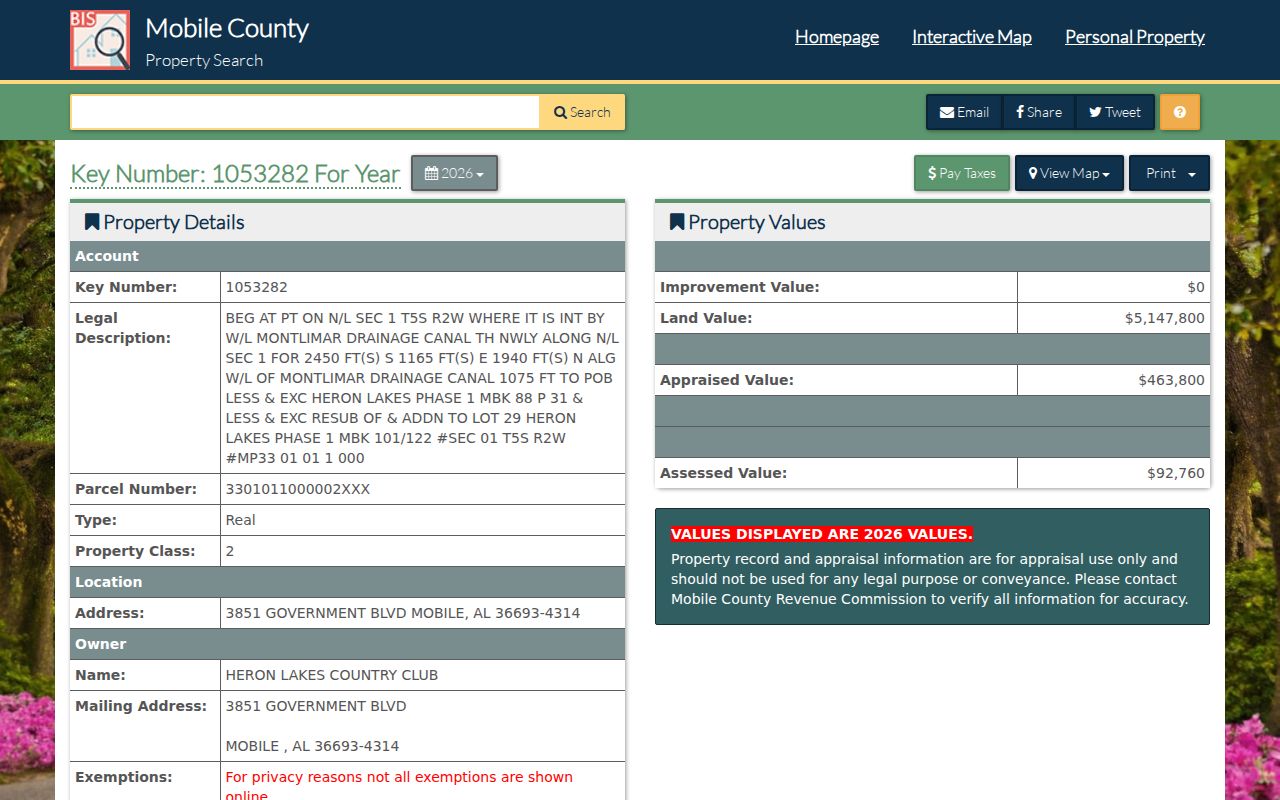
Treat the deed-history reference as your path to Probate.
Mobile County Property Record Types
A property history uses several record layers. Recorded instruments document transfers and claims. Assessment files organize value and tax data, plats and GIS locate the lot, and civil or probate cases may explain disputes or estate transfers.
| Record Type | What It Documents | Kept By | Access |
|---|---|---|---|
| Deeds | Transfers, parties, dates, legal descriptions | Mobile Probate | Index, images, counter, copies |
| Mortgages and liens | Recorded claims and releases | Mobile Probate | Landmark and Records Division |
| Tax and assessment | Owner label, value, exemptions, payments | Revenue Commission | Citizen Access and offices |
| Plats and parcels | Lot framework and mapped place | Probate and GIS | Books, images, public viewers |
| Permits and zoning | Land-use and improvement review | Applicable city or county | Portal or records request |
Deeds cover recorded transfers, Revenue gives the current assessment lead, and plats show the recorded lot form. Court dockets can flag a dispute. The order and any later instrument still need review.
Mobile County Maps Need Records
The county GIS page offers the Researcher Map plus printable map routes. City of Mobile services layer on county-derived parcels, subdivisions, zoning, flood zones, historic districts, annexations, roads, and planning jurisdictions. Parcel fields can include subdivision, lot, parcel, key, name, street parts, city, and geometry.
A mapped line is not a survey. When an easement, drainage path, shared drive, or lot line matters, inspect the recorded plat. Inspect the deed it references too. A ZIP name cannot prove city limits either. Corporate-limit and planning-jurisdiction layers answer that question.
Mobile County's Attic Archive
Modern portals tell only part of Mobile's land story. In 1989, colonial and historic records turned up in a courthouse attic. That find led to the Records Archives Section. Holdings span translated records from 1715 to 1841. French and Spanish material sits beside old wills, township maps, early plats, St. Stephens Meridian work, and Army Corps surveys.
That history changes your search words. An old deed may cite a ward, tract, road, ferry, survey, or vanished place name instead of a current street address. Legal descriptions can bridge old terms to the modern parcel. For fallbacks, turn to the Probate archive and the Mobile Public Library Local History and Genealogy Branch.
Mobile County Tax and Court Clues
Revenue separates appraised value, assessed value, exemptions, jurisdictions, and payment history. Alabama assessment levels vary by class. So assessed value is not a likely sale price. The Board of Equalization hears value protests, while the Revenue Commission handles billing and collection.
Foreclosure and quiet-title cases go to the Thirteenth Judicial Circuit Civil Division. Alabama Court Records Access offers name and case-number searches with paid access. A docket never updates the deed chain alone. Carry the final order and any recorded instrument back to Probate.
Mobile's 2026 tax-lien auction produces a lien certificate subject to redemption. The certificate does not transfer title. Keep delinquency, auction, certificate, redemption, court action, and any later deed separate.
City Layers Across Mobile County
Mobile County handles the title work, but cities add layers. The recorder and assessor keep deeds, plats, and the tax roll for the whole county. Cities then contribute their own facts. Mobile publishes mapping, annexation, planning, and historic layers. Prichard holds City Clerk and Inspections records. Saraland covers planning, zoning, flood, wetlands, annexation, and permit routes.
Annexation shows why city context matters. Mobile's 2023 annexation moved more than 19,000 residents into city services. It shifted city-limit, council, trash, and planning details without touching the county deed system. Saraland's planning jurisdiction also stretches 1.5 miles past its city limits. So a mailing address alone cannot settle zoning authority.
For city-level digging, continue with Mobile property records. Prichard and Saraland questions still come down to a county parcel number. That number gets matched against a Probate instrument.
Mobile County Fraud Alert
Mobile Probate offers a free Fraud Alert service for land records. Register a personal or business name. The office emails you whenever a new document is recorded under that name. You can confirm registration, edit your entry, or unregister at any time. The match works off the name alone. So probate recommends listing spelling variations. The system cannot promise it will catch every identity match.
The official Fraud Alert form delivers notice only. It is not a freeze, and it does not correct a recorded deed. Statutory redaction handles eligible officials and specified data through a separate process. Neither tool removes an ordinary public document from Mobile County's records.
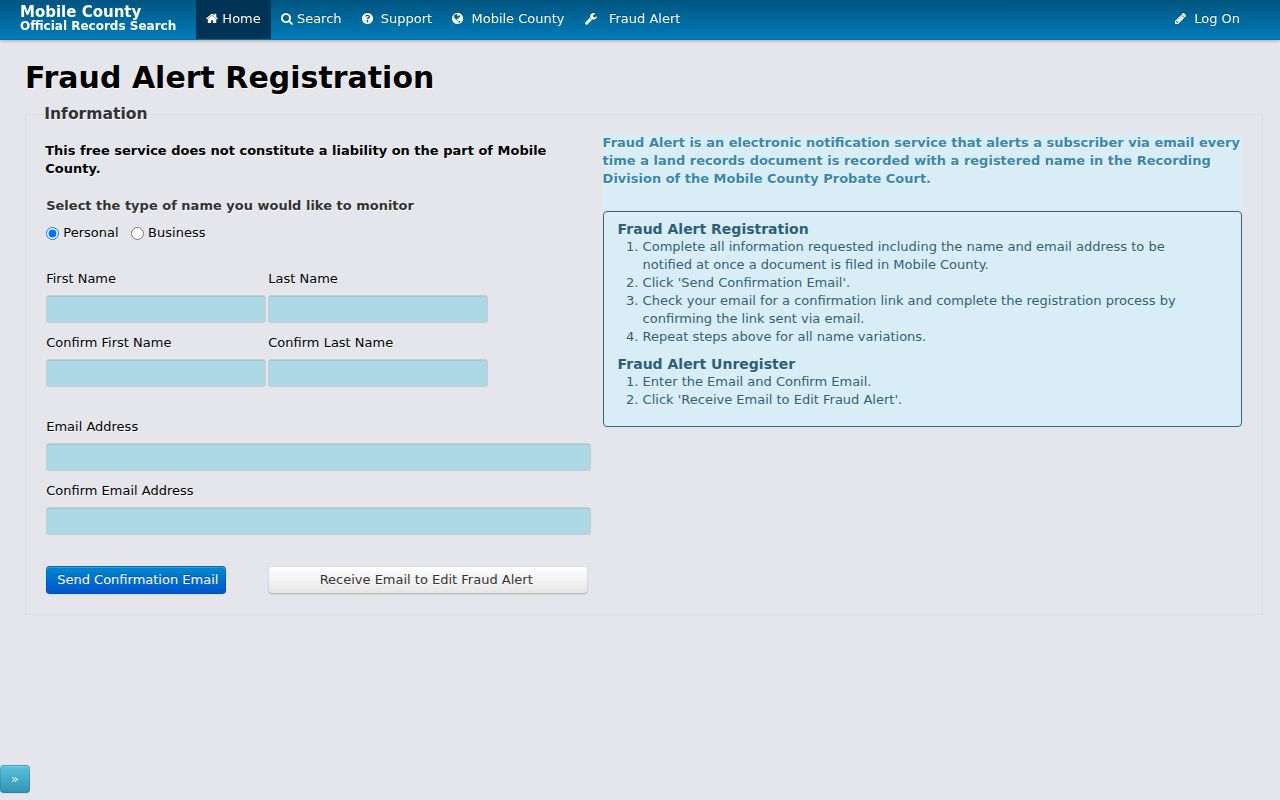
Register meaningful name variants, then compare any notice with the actual recorded image.
Limits of Mobile County Property Records
Mobile Probate offers a free Fraud Alert. It emails you when a land-record document is recorded under a name you register. Personal and business names both work. You can confirm, edit, or unregister through the same route. Probate recommends registering spelling variations, since a name-based notice cannot guarantee every identity match.
The official Fraud Alert form is a notice tool, not a freeze or correction. Statutory redaction is a separate process for eligible officials and specified data. Neither one erases an ordinary public deed.
Lawful use. Use Mobile County property records for legitimate diligence, history, and civic review. Never use owner data to stalk, harass, or harm a person, and rely on qualified professionals for title or boundary opinions.
Mobile County Legal Descriptions
Official records can show an assessment owner of record, a recorded conveyance, a mapped parcel, and value fields. They can also show recorded claims. They cannot prove a mailing address is a home. A GIS line is not proof of a survey, and an index search may not catch every interest. Trusts, estates, entities, name variants, splits, and update lag all demand cross-checks.
Keep the source, query, parcel IDs, record date, tax year, and book/page or instrument. Also keep the date viewed. Compare the newest deed against the Revenue name and legal description. Trace older chains by grantor rather than treating a street name as timeless.
Mobile County Public Access Channels
An address is convenient. The legal description is the stronger bridge across Mobile County property records. It may name a subdivision, phase, unit, lot, block, and map book and page. Or it may cite a section, township, and range. Older tracts often use metes and bounds. These walk the boundary with calls to roads, water, section lines, or adjoining owners. Those calls can preserve an old place name long after a street label changes.
Use the full description when a common owner name returns several parcels. Use it, too, when an address changed or a tract was split. Compare the Revenue description with the newest deed and the recorded plat. A short tax-card summary may omit detail. When a phase or unit appears, keep it in every search. Similarly named sections may come from different maps and carry different easements or access terms.
The parcel number, Revenue key, and City KEYX help locate a candidate. Public sources do not treat them as synonyms. Label each field and record its source. That habit keeps a valid number from being attached to the wrong parcel.
Mobile County Value Dates Matter
A portal is only the first route. Mobile Probate offers Landmark WEB, document images, Records Division research, inspection, counter service, mail contact, and copy or certification requests. If an image falls outside online coverage, note the book, page, parties, instrument type, and date. A precise request is easier to route than a demand for every document tied to a street.
Revenue provides its property search, tax and payment information, map links, and office contact. Current notices say offices close Wednesdays and satellite operations can change, so verify hours. The Board of Equalization is a separate value-review route. Court records use statewide on-demand access plus local Circuit Civil copy procedures. Libraries, Municipal Archives, and Probate archives serve as fallbacks when modern indexing does not fit.
County material that is not published may go through the current records-request form, which asks for a date range, a description, and Alabama resident certification. It may require identification and describes response timing, labor or copy charges, deposits, and payment limits. That county process does not replace Probate's land-record workflow or a City planning request.
Mobile County Deed Chain Checks
Ownership questions often start at Revenue, yet the recorded chain lives with Probate. Pull the newest deed-history reference from the parcel card first. Then open the actual instrument and read it closely. Note the grantee, the grantor, the recording date, the deed type, and the book and page. Also record the instrument number. Capture the consideration if stated and the full legal description. Compare that description against the parcel you selected. A shared surname proves little on its own. Entities, relatives, estates, and common names make name matches especially unreliable here.
Working backward takes patience. Search the current grantee as a grantee in earlier years. Then find the deed by which that party acquired the same land. The prior grantor becomes your next link. Keep repeating the process, matching the legal description at every transfer. Along the way you will meet warranty deeds, quitclaim deeds, personal-representative deeds, tax-related instruments, and court-directed transfers. Each label carries its own meaning, so record the instrument type rather than assuming a standard sale.
The online trail eventually ends. Probate's own history places the deed books at 1813. The online index and image windows start far later. For older Mobile County property records, turn to real-property books, deed books, microfilm, direct and reverse indexes, and the archive. Early entries may use French or Spanish names, historic wards, township language, or survey references. Try spelling variants freely. Still, let the land description decide whether a name belongs in the chain.
Plats merit a separate check. One deed may cite a subdivision, unit, phase, lot, and map book together. The plat can reveal streets, dedications, easements, rights-of-way, drainage features, setbacks, and lot geometry. A short assessment description leaves those out. GIS helps you find the modern candidate parcel. The filed map and the deed supply the recorded trail. Does the chain affect a purchase, dispute, inheritance, or boundary decision? Get official copies. Seek qualified title or survey advice.
Record the source date and exact land description before relying on any final match.